Posts

Showing posts with the label REDOX Reactions

How to identify OXIDIZING & REDUCING agents in REDOX Reactions./ Steps, examples, and concept points/
Image
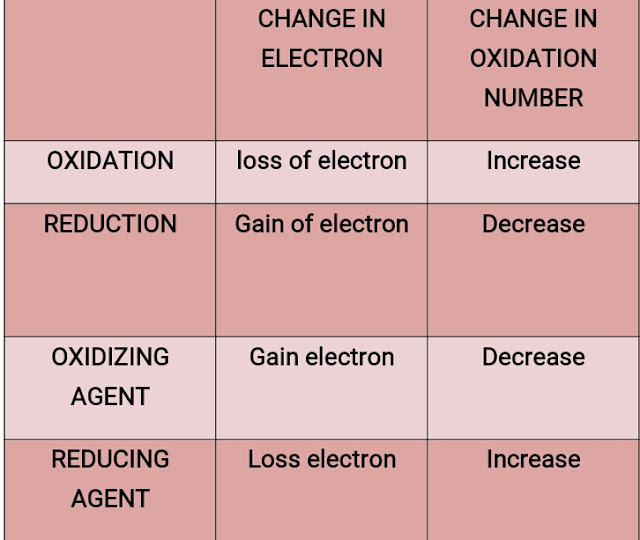
Points To Recall Oxidation occurs by loss of electron/s and during oxidation process, oxidation number increases. Reduction occurs by gain of electron/s and in reduction process, oxidation number decreases. OXIDIZING agent cause oxidation in a reactant and get reduced during Redox reaction. REDUCING agent cause reduction in a reactant and get oxidized during Redox reaction. As,   REDOX Reactions   occur with change in oxidation states/numbers of elements in reactants before and after reaction in reactants and products So, the key point in the identification of oxidizing and reducing agent is to have deep look at the change in the oxidation states of each element in reactants  and products. OXIDIZING and REDUCING agents ' identification steps Determine oxidation states of each element in balanced chemical equation. Figure out elements which are changing their oxidation states in REDOX chemical equation at both side - in reactants and products. Element showing i...

OXIDATION NUMBER/ Definition, Rules, Concept Points, Examples/

Image
A compound or molecule is electrically neutral - have " zero"  algebraic sum of charges - chemical species. Atoms of elements, in compound ,carry charge, that charge on atoms in chemical species is called OXIDATION NUMBER of element in compound. Oxidation number is also referred as OXIDATION STATES . In case of polyatomic molecules, algebric sum of oxidation number of each element will be equal to charge on polyatomic molecules. Examples of both cases , compound and polyatomic molecules, is discussed below.  Definition Oxidation number is the charge number either positive or negative on atoms of elements in a compound. This charge represents the ability of share, gain or loss of electron to form bonds with other elements in compound. Rules For Assigning Oxidation Numbers oxidation number or state of certain elements are assigned by following rules. Oxidation number or state of elemental forms like H2, O2, P4, S8 Cu, Al etc are always "zero" Elements of IA(Alkali me...

OXIDIZING AGENT & REDUCING AGENT( in term of electron gain and loss)/Definition, Concept points, & Examples/

Image
  Definition An oxidizing agent -also known as "OXIDIZER" and "OXIDANT"-is a reactant that oxidizes other reactant, by accepting its electron/s. So, oxidizing agent is electron acceptor in   REDOX Reactions . Examples: O2, O3, Halogens, Sulphuric acid, Nitric acid, and Potassium nitrate. A Reducing agent - also known as "REDUCTANT" - is a reactant that reduces other reactant, by donating electron/s in REDOX Reactions. So, reducing agent is electron donor in REDOX Reactions. Examples: H2, CO, Fe, Zn, Formic acid, Alkali metals and Sulphites etc Concept Points to remember In an oxidizing or reducing agent only one atom is accepting or losing electron/s respectively, not the whole agent. That atom - electron acceptor atom- usually exist in highest oxidation state in Oxidizing agent  That atom - electron donor atom- typically exist in lowest possible oxidation state in reducing agent.    Oxidation number/state of that atom- that accepts electron/s- decreases....